Sunday, April 10, 2011

Wilkommen, Bienvenue, Welcome....


Well, I'm finally packing to return to Tana Lepre (Hare's Den). One reason I'm late getting back this year is I wanted to stay in New York for the opening of a Broadway musical whose title most Italians would appreciate. In this revival of the depression era extravaganza, Anything Goes, our dear friend Joel Grey plays Moonface Martin. He's not just one of the world's most gifted stage and screen performers, he's a darn good photographer. Here he is doing his darndest to upstage Sutton Foster in the sparing number "Friendship."

This Monday, he'll be honored with an eponymous exhibition by The Museum of the City of New York. It also happens to be his birthday.

Happy Birthday Moonface!


Friday, March 4, 2011

Win-Win Sharecropping

Being a writer married to a photographer and having wonderful friends in the arts and sciences means I get to do some pretty cool things. For instance, I remember sitting opposite renaissance funny man Steve Martin in his limo immediately following the Broadway opening of his play “Picasso At The Lapin Agile” as he cracked, a little nervous about reviews, “I’m still just the son of a poor sharecropper.”

What does this have to do with Tuscany, you're wondering?

Sharecropping is still alive here in Tuscany, but not in the way you would think. Besides the fact that the feudal mezzadria (half-sharing) system wasn’t outlawed until 1964 -- which makes almost anyone still farming in Italy literally the sons and daughters of poor sharecroppers -- there are those of us who think an updated version of crop sharing might hold promise, especially in these times when “think global, act local” is the viable path toward sustainability, stability and health.

I’m one of those people. So is Pienza-based cheese maker Ulisse of Podere il Casale. By virtue of being abandoned for over 10 years, our farm is certifiably "organic," so I call the new system we are setting up mezzadria biologica -- organic crop-sharing. It starts with the kind of barter I spoke of in my "Bragging Rights", post about giving away our plums in return for a case of the delicious plum preserves they were transformed into. The next step was when Sally contacted Ulisse, a Swiss cheesemaker over by Pienza and he brought his team of WWOOF volunteers to help harvest our olives. For this service he took half the oil, our best vintage yet. It was a great deal we plan to continue because till now we've only been able to harvest half our trees ourselves anyway. In the end we got a cheese credit as well!

What is WWOOF, but a form of sharecropping? Unlike today's internships, where college grads become unpaid slave-apprentices hoping to get offered a job, Wwoofers give labor in trade for education, room and board in beautiful locales like ours. Everyone is happy in the end.

Now, I am in talks with Ulisse to sharecrop our large orto (garden) in exchange for his products, and perhaps to graze his sheep on our fallow wheat field. The sheep will improve the soil with their manure and keep noxious weeds down, while enjoying free-range health. And I won't have to mow!

But just as good as its practical win-win economics, neuroscientists are now finding that the pleasure centers of our brains light up when we share, making sharecropping a feel-good thing to do.

Sunday, February 27, 2011

Town & Country

It is hard blogging about the farm when I am away from it for the winter. This is why my posts tend to thin a bit once I've returned to New York in January. I just don't have the callus-building hands-on daily experience to write from. So, I will continue to write about what I know and experience in contrast to my life on the farm. Which means a little bit more about the gentleman in the gentleman farmer. So here goes.

Sally and I do the New York-Tuscany shuffle. We do not disagree with anyone who says we have the best of both worlds. But right now the farm is asleep. The new wine is quiescent in the cool cantina. The new olive oil is thick as green lard in the cans. In two months the oil will thin and settle, the wine will fizz once again, and the buds on the prune and peach trees will pop. And I will be there for it. But right now who is Jack without all this?

Sometimes I feel like Forrest Gump, a super-lucky nobody among somebodies. Imagine me at my friend Jean Pagliuso's opening of her "Poultry & Raptor Suites" at the Marlborough Gallery a few nights ago. Jean renders exquisite black and white portraits of seemingly unlikely subjects until you see them and realize the personality in each once it's rendered on specially prepared mulberry paper.

The subject (above) and the work.

I took my friend, Italian movie producer Roberto Bessi (Ladyhawke, A Good Woman, Modigliani, etc.), to the opening. He has been here the last four days, drumming up interest in several projects we are developing together, including a romantic comedy based on my experience reclaiming the abandoned Tuscan farm.

Afterwards, Sally, Roberto, and I went to a cozy after party at the home of Jean and her husband Tommy Cohen, where Roberto pretty quickly struck up a conversation with an old acquaintance, Jeremy Irons. I was also able to reconnect with many of the people I missed over the 9 months I was working on the farm, including Managing Editor at Sports Illustrated, Terry McDonell, amazing figurative painter Eric Fischl and his wife, landscape painter April Gornik. Susan Minot, Bryan Hunt, surgeon-author Jerry Imber, and other friends were there, as well. Thanks Jean and Tommy for a bright night in a long cold winter.

Sometimes I can't believe my life. When I'm not doing what I love on the farm, I'm doing what I love in the city that never sleeps. Farmer Jack is one very lucky gentleman.


Thursday, February 24, 2011

Thumbs Up


I thought I knew my anatomy. It took a vineyard to teach me I don't have a single muscle in my fingers. That's right. Fingers are all bone and cartilage and sinew. A puppet master system of tendons sliding through sheaths of fixed tissue, so called "cables and pulleys," makes our hands work. Only when tugged by muscles in the palm and forearm do the strings that run to the tips of our fingers give us grip.


Most people know about a grip related repetitive stress problem called carpal tunnel syndrome. This involves pinching a nerve in the wrist. And of course there's arthritis of the joints. But there's another problem that arises when the connective tubes or tendons at the base of the fingers gets inflamed. It sounds like something cold war spies used to get. I got my "trigger finger" (of the thumb) from the mundane, repetitive, meditative activity of pruning thousands of grapevine stems.

Let's hope the shot of cortisone and the splint and some time off for winter do the trick. I have to get back and get the fruit trees pruned before bud break.

Wednesday, January 19, 2011

Hand Language

Everyone knows Italians speak a lot with their hands. But what do they mean when they gesture? Some things are obvious. Grab the crotch to keep away the devil when you see something bad, flick your chin with your fingers at someone who is an insufferable bore in the north or to say "can't park here" in the south. There are some naughty ones that involve fists and fingers, and some very sweet ones like waving with a beckoning backwards clap of one hand (Italian zen for "Come back soon!").

Here is our dear friend Gianni Marriotti, captured by Sally. It may look like he's describing a really big truffle he found, but he and I were discussing the fine points of living well and the importance of remembering the past. He is talking about connecting to what is deep and fundamental and keeping story alive.

Here it looks like he's telling me how I could grow really big tomatoes if I traded a few to a farmer for some good manure, but he is really talking about the advantages of the non cash-based barter system that was in place in rural Tuscany until very recently, and how it kept dealings honest.

It may look like he's talking about what it takes to be president of the United States of America, but he's really talking about what it takes to enjoy life -- family and friends.

This is not what you think. He is talking about what makes Gianni Gianni.

And it is this, the talk, with hands or without hands, but definitely with friends, that makes living well, in Italy and anywhere else, living positively and optimistically, with one palm up in an attitude of grateful receiving, and one toward the heart in sincerity.


Friday, December 31, 2010

Giovanni's Hog


I'm a little jet-lagged, having just returned to New York.

One of the reasons I stayed in Italy until the last day of the year was to participate in one of the most important and certainly the last of agricultural rituals in the annual cycle of rural Tuscan life -- the slaughtering of the family hog.

I'd waited for nearly a year and in November, when I asked Giovanni when it would happen, he answered in his raspy Tuscan dialect: "Around Natale (Christmas), maybe Capo d'Anno (New Year's Day). It has to be cold."

I said I wanted to help him do it, wanted to experience it alongside him and to document it. I asked him to promise he'd let me know when it would happen. He grinned at this. It wasn't his usual Errol Flynn "Welcome to Sherwood!" grin, but a limper, more introspective version. I now understand the enigma in that look.

Thinking the event was imminent because the weather had been unusually cold, Sally and I stopped by a few days before Christmas to ask when the slaughter would take place. Giovanni looked a little sheepish, then said it was already done. I asked when he'd done it and he said just that morning. The meat was hanging from the tractor boom in the barn. We could see it for ourselves if we wanted.

What we found suspended in the barn were two identical slabs of pork with the last bit of blood dripping from the cloven snout. Giovanni had introduced me to this same white hog one year earlier, just as I was starting this blog. He fed it corn and petted its snout and spoke sweetly to it. Milena fed it slops from her kitchen. It lived in a very nice pigsty, actually a small house with windows and a tile roof which it shared with another black hog. When I asked how much food was hanging there, Giovanni said half of the carcass would feed his family for half the year, the other half would feed his cousin's family for just as long. Then I asked why he hadn't alerted me so I could participate.

Giovanni dropped his voice apologetically. His eyes moistened slightly. "E brutto," he muttered. It's ugly. He meant the slaughter.

I understood. It is a very personal thing. He hadn't really wanted me to watch as he spoke softly to to the hog, saying his thankful good byes before he shot it in the head. I respect this very much. I hadn't helped raise this animal. I hadn't fed it scraps from my own table. Giovanni and Milena and Arnaldo really live with their animals. They treat them well while they are alive, then they kill them as humanely as possible to put food on their table. I'm sure there are struggles and messes and mistakes, just as there are when we raise our own children, but it's a natural permacultural cycle involving interdependently evolved domestic animals (us and them) both of whom -- at least in the case of close-to-the-land folk like the Mangiavacchis -- enjoy a far higher standard of living, and in many cases longer and healthier lives, than they would if disconnected from their hosts in the wild. Which brings me to my New Year's thought.

Without connection, there can be no respect. Yet most of us in the developed world live at a disconnect to the food we put in our bodies. We think meat is something that comes from a supermarket and most of us who eat it don't even know we are unplugged. Some of us stop eating it when we realize it was once a living animal -- a reactive and equal disconnect in many ways. The fact is, with the exception of rock-eating extremophile bacteria, every living creature must eat living things to live. Even plants depend on the nitrogen that comes from animal kingdom protein, some of it from us when we die and re-enter the planet-wide cycle of life (if we haven't stingily pickled ourselves and hermetically sealed our nutrients in aluminum coffins). I'm sure some people have already looked at the picture above and thought it repellant and stopped reading. For those who haven't, I want to say it is a portrait of the admirable and connected conscientiousness Giovanni and his family practice. And a reminder that, whether or not we chose to sustain ourselves by eating animal flesh, we could all stand to be more connected and to better respect the living things that die to keep us living in this amazing worldwide ecological niche we human beings occupy and share.

Happy New Year, Earthlings!


Sunday, December 26, 2010

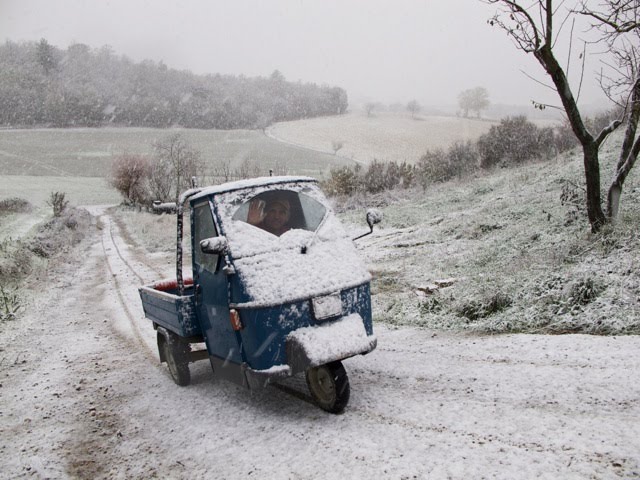
Snow!

Merry Christmas Everyone!